Solidarity with Palestinians in the face of genocide has been met with disregard within many Northern European academic institutions. Accusations of a “lack of nuance” and outright silence on the topic are some of the softer ways used to discourage critical engagement with, and support for, the Palestinian struggle for political and human rights.
In 2024, we organized two public events on settler-colonialism in Palestine at a Swedish university where we both worked at the time. These, as well as events following them, were met with disregard and disengagement.
Based on these experiences, we find it crucial to reflect on the silences and silencing we faced. Both were often justified in the name of what we would call nuance, a term often used to positively describe critical research and complex analysis. However, contrary to the critical engagement and learning that the term usually suggests, in the reactions we have received it is used to legitimize what anthropologist Ann Stoler has called the ”politics of disregard”.
We understand the politics of disregard as the decision to treat certain knowledge as irrelevant, or to minimize its significance. It functions as a form of epistemic power, by which we mean the power to determine what knowledge is true, valid, and credible. The silences then become forms of epistemic violence – that is, harm caused by the systematic invalidation or erasure of non-dominant knowledge and experiences.
We hope to draw attention to how claims to critical thinking and nuance can serve to legitimize the knowledge of colonizers while silencing other perspectives.
Given our different involvement in the events, we write both from our individual perspectives and as a collective voice. In doing so, we wish to underscore that different experiences do not hinder collective work. On the contrary, they are the foundation for solidarity and nuanced knowledge.
By detailing the practicalities and personal experiences in organizing these events, we show that silence operates on and across institutional, social and emotional levels. By making visible what silence does and how it is rationalized and produced in academic institutions, we hope to contribute to ongoing global efforts to break the silence surrounding Palestine.
What follows is a reflection on specific events by each of us, including the proposal of the initiative and the organisation of a film screening and a research seminar. We discuss how criticism of these events as “too political”, “one-sided”, and “irrelevant” are justified through claims that the topic is “complicated” or “uncomfortable” and requires nuanced understanding. We argue that these claims foreclose the possibility of learning and deflect accountability.
Luca’s experience of introducing the idea of a film screening on Palestine
In December 2023, as I was witnessing the escalation of Israeli violence into what would become a genocide, I felt an obligation as a feminist scholar to address the situation at my university.
I thought that a simple film screening followed by a discussion would allow me to create a space for trying to understand what was happening, and to reflect on our roles and responsibilities as researchers and teachers – a space for learning not only for the students but for all of us.
In the last staff meeting of the year, I brought up the idea to my colleagues and shared a bit about the emotional impact the assault on Gaza had had on me, and my motivation for engaging with the topic. Going into the meeting I had expected an opportunity to introduce my suggestion and to address any possible questions or concerns from my colleagues – much like with other initiatives for academic events.
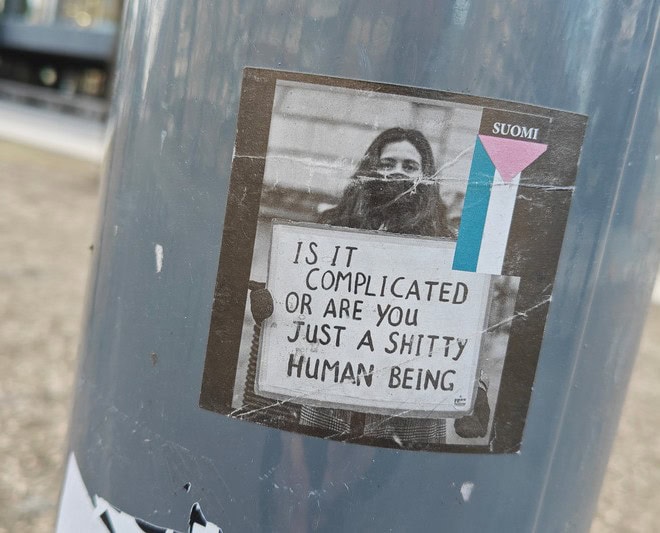
Especially as I was working in gender studies, I trusted in the support and shared sense of urgency and responsibility from my colleagues. What followed instead was a situation dominated by a puzzling (in a work setting) emotional outburst from one colleague, and near-complete silence from others. The discussion, and myself, were shut down by labelling the event as too “one-sided” and the topic “complicated”.
In a collegial community, where collective discussions and decision-making had previously been valued over strict hierarchies, the silence of some – and direct attempts at silencing by others – was striking and spoke to the power imbalance in the situation.

I was left alone to handle the outburst and the feelings of my colleagues, as well as my own. This is a dynamic that has continued to repeat itself during the years following this meeting.
However disappointed I was in the meeting, I continued to push for the idea. While a single film screening may be a small and comparatively insignificant event, I could not reconcile myself with the idea of remaining silent and passive without losing my sense of humanity and integrity as a scholar.
Remembering the words of a fellow activist in a documentary I saw, sometimes our activism does not change the world, but we continue doing it to not let the world change us.
Luca on including “both sides” as a claim for “nuance”
Finally, after agreeing to particular requirements, I was given permission to organize a film screening followed by a discussion with an invited scholar. This eventually expanded into two separate screenings, both of which Xin joined me in organising.
One of the requirements was that we include Israeli filmmakers or scholars – include “both sides” as it was formulated.
This requirement equated nuance with ethnic or national identities, rather than with the diversity of participants’ viewpoints and expertise, or the themes and genres of the films.
What nuance seemed to mark here was merely the physical presence of Israel. This demand in effect presents a troubling validation of colonial domination.
It also begs a consideration of the meaning of nuance – does it mean inclusion of all possible perspectives? Or can it be an ethical and critical stance, an understanding of the differences, histories, and power hierarchies between those perspectives?
“Both sides” as a formulation is not only politically charged, it in fact flattens nuance into a false dichotomy of two supposedly equal and homogenous sides. In reality, equality is here nothing but an illusion that obfuscates, and even justifies, settler colonialism, occupation, and ethnic cleansing.
This restricts Palestine to always, and only, being understood in relation to Israel, and through the dominant narrative of “conflict”. In effect, the insistence on nuance, understood as the inclusion of Israeli participants, reproduces colonial ways of understanding and framing the conversation while silencing other voices.
Xin’s experience of joining the initiative
I was one of the colleagues who remained silent during the staff meeting. Even though I was supportive of Luca’s initiative, I was unsure of what to do or say at that moment. My experience of these meetings was that they were usually warm and collegial spaces for discussing issues related to teaching and research. That is why it came as a surprise that Luca’s proposal was met with anger and quickly shut down.
The angry response felt like an immobilizing shock. I did not intervene in the situation partly because I did not understand where that anger came from. But mostly, I chose silence because it was the easiest option, especially when everyone else did the same. It was a safe choice, both for maintaining a good relationship with colleagues in a relatively new work environment, and for managing my discomfort at that meeting.
Although I have taught and read feminist critique of comfort – the feeling of sinking into a big, soft sofa – as a bodily experience of fitting into societal norms and established power hierarchies in everyday and institutional spaces, I chose the more comforting silence.
I regretted my silence afterwards, and once the events got the green light, I joined Luca in organizing them. These free events were envisioned to offer a public platform where researchers, filmmakers, students and members of the public could come together to learn about and discuss issues related to settler colonialism and genocide.
Organizing the events
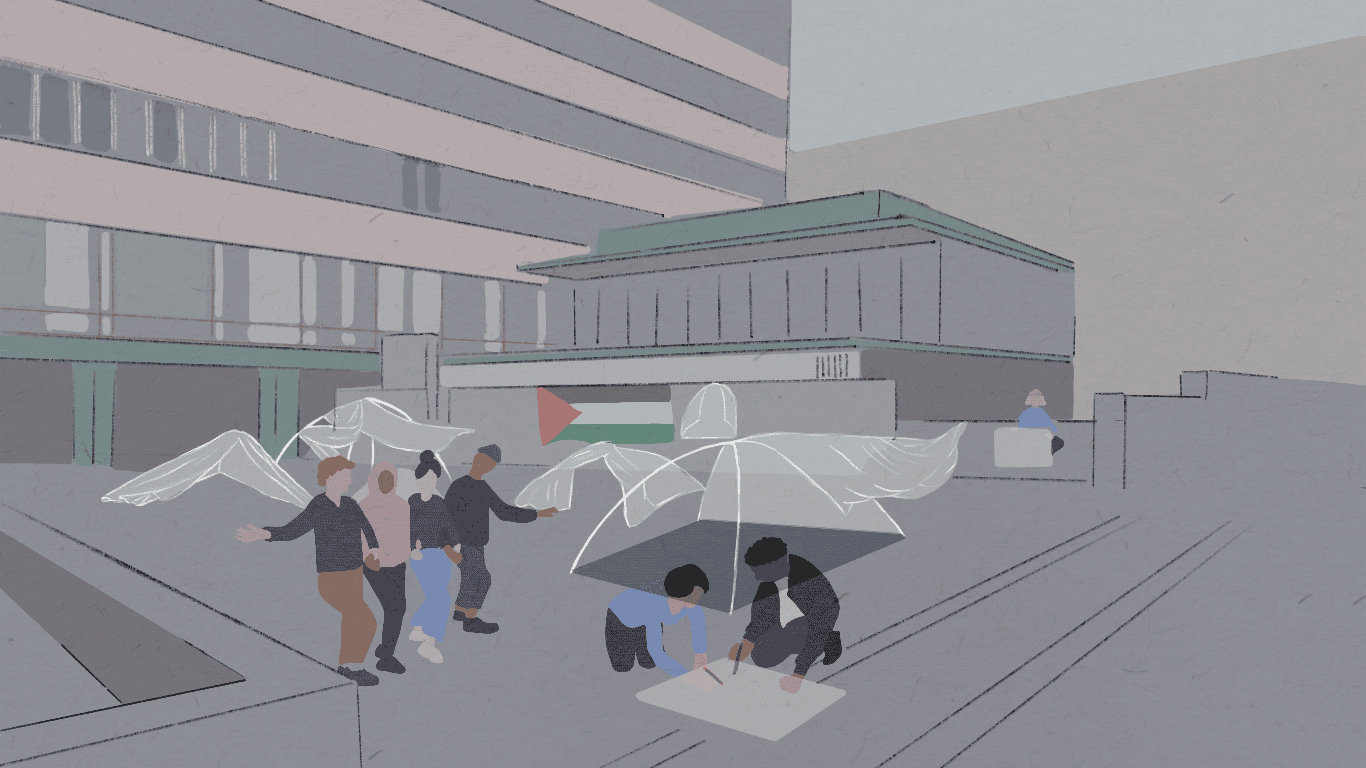
To make the events as accessible as possible, we chose an independent cinema located in the city library for the first event, and a university lecture hall for the second. We also borrowed a projector from the university and shared the screening link with the students at the Palestine solidarity encampment so that they could join the screening and discussion online.
For the first event, we screened the 2022 speculative documentary film Foragers by artist and filmmaker Jumana Manna. The film was shot in the illegally occupied Golan Heights, Galilee and Jerusalem.

As a speculative documentary, the film incorporates a variety of materials including fiction, documentary and archival footage. It explores Israeli criminalization of the Palestinian custom of foraging for native wild plants like akkoub and za’atar. As Manna explains, “For Palestinians, these laws constitute an ecological veil for legislation that further dispossesses them from their land while the occupation’s state representatives insist on their scientific expertise and duty to protect”.
For the panel discussion we invited Dr. Minou Norouzi, an artist and film maker based at the University of Helsinki, and Dr. Silvia Hassouna, a cultural-political geographer based at Durham University working on questions of biodiversity and colonialism in the context of Palestine-Israel. We invited Norouzi and Hassouna because of their engagement with Palestine and their respective expertise in documentary filmmaking and ecological relations under settler colonialism, which were relevant to the film.
Norouzi, who suggested the film to us, criticizes the idea that documentaries should strive to solicit empathic engagement. She argues that empathy produces a “feel-good” illusion of the viewer being brought close to the onscreen suffering and instead proposes the ethical labour of discomfort, in which the viewer is refused identification with and proximity to the on-screen others.
Xin on claims of “nuance” and silence
As I see it, both the film and the event were intended to encourage the ethical labour of discomfort. Rather than involving dramatic and linear plots, the film quietly follows the plants and people in multiple places, landscapes, and institutions.
The film refuses to offer the viewer a plot with which they can identify and sympathize. It also complicates the familiar narrative framing of Palestine-Israel dynamics by centering the human-environmental relations under settler colonialism.
Through these strategies, the film solicits discomfort, not through an onscreen display of violence and suffering, but by compelling the viewer to sit with the difficulty of grasping the intricate social, political and ecological relations that are both real and fictitious.
The viewing experience may also be discomforting because it requires the viewer to do the work of learning how environmentalism is recruited by the settler colonial regime. More fundamentally, it prompts the viewers to reflect on how “feel-good” narratives of love for nature and empathy for the oppressed become complicit in colonial domination.
The film screening was therefore a pedagogical event. In my approach to pedagogy, I follow feminist and decolonial theorization to underscore a mode of knowledge production that centres on the question of power. This includes the power asymmetries between the viewer and what is onscreen, as well as the colonial scientific expertise on nature conservation and the embodied knowledge and practices of foraging.
The panel discussion further broadened the scope to include issues of film-making and biodiversity in the context of Palestine. The result of the film screening and panel discussion was nothing short of a more complex understanding of settler colonialism.
In light of this, I was struck by the responses that the event received. Even though we received funding from the university, we were told not to advertise the event as hosted, but merely supported, by the institution on the event poster.
Although some of the staff were very helpful, the cinema did not advertise the event in their calendar. This seemed to be on purpose, as implied by a staff member. Very few colleagues and students came to the events. And some colleagues expressed discomfort that discussions about Palestine were “too political”. Others referenced the October 7 event, suggesting that we needed more knowledge and more nuanced understanding.
Ironically, the aim of the film screening was to create a space for producing nuanced and complex knowledge and for imagining Palestine beyond the dominant narrative framings of war.
I recognize the importance of nuanced analysis. In feminist research, analytical nuance has involved, for instance, reworking oppositional accounts, such as those between the subject and the object, mind and body, culture and nature, and masculinity and femininity.
Similarly, decolonial studies have critiqued the oppositional logic of war and proposed an ethos of reparation.
In my view, which is strongly informed by these two knowledge traditions, the film’s portrayal of the multiple lived and imagined human-plant relations under the settler colonial regime offers a nuanced perspective on how protection and care can function as violence and destruction.
I was therefore confused by the use of nuance as a form of criticism, especially when coupled with an evaluation that the event was “too political”.
How does a term that signifies critical analytical endeavours – an intimate mode of thinking and writing that feminist theorist Sara Ahmed calls a labour of love – become mobilized to foreclose possibilities of engagement and learning?
Is there an order of “before and after” whereby a certain amount of knowledge is required before critical learning and reflection can begin? By which criteria and from what standpoint is sufficient knowledge measured?
Furthermore, if nuanced understanding requires the effort to learn about, reflect on and discuss different viewpoints and perspectives, why would a public film screening and panel discussion event not be a fitting platform? After all, film screenings are a common pedagogical tool in many disciplines.
Luca on selective nuance and “discomfort” as silencing
Besides being pedagogical tools, film screenings also effectively carry out the first and third missions of the university: educating, and engaging with, society.
In this sense, film screenings function much like seminar talks. Not long after the film screening events, US-based Israeli scholar Dr. Maya Wind was invited to speak at several Swedish universities, ours included. Wind’s talk was based on her 2024 book Towers of Ivory and Steel: How Israeli Universities Deny Palestinian Freedom, which documents the complicity of Israeli universities in the occupation of Palestine.
The seminar was allowed but the relevance of Wind’s talk for gender studies was questioned by our professor, even though the very notion of complicity has been a central tenet in feminist research. This left us in a cross-current. On the one hand, we faced demands for more nuanced – that is, wider – understanding. On the other hand, the proper objects of knowledge for gender studies were narrowed down and excluded the occupation of Palestine.
What does nuance mean if certain questions of power, inequality, and injustice are excluded, while others are seen as relevant for the discipline? Much like the film screening, the seminar was an opportunity to learn, but again only a few colleagues or students attended.
To come back to Norouzi’s formulation of discomfort as ethical labour, I feel like the film screenings were meaningful to those who participated, but they did not succeed in creating a broader space for critical reflection on the genocide and our roles as feminist scholars and members of the global academic community – that is, they did not create a space for the ethical labour of discomfort.
The success of discomfort as pedagogy can be measured, according to scholar of social justice education Megan Boler, by “the ability to recognize what it is that one doesn’t want to know, and how one has developed emotional investments to protect oneself from that knowing.” Ironically, this ability would in itself require sitting with discomfort.
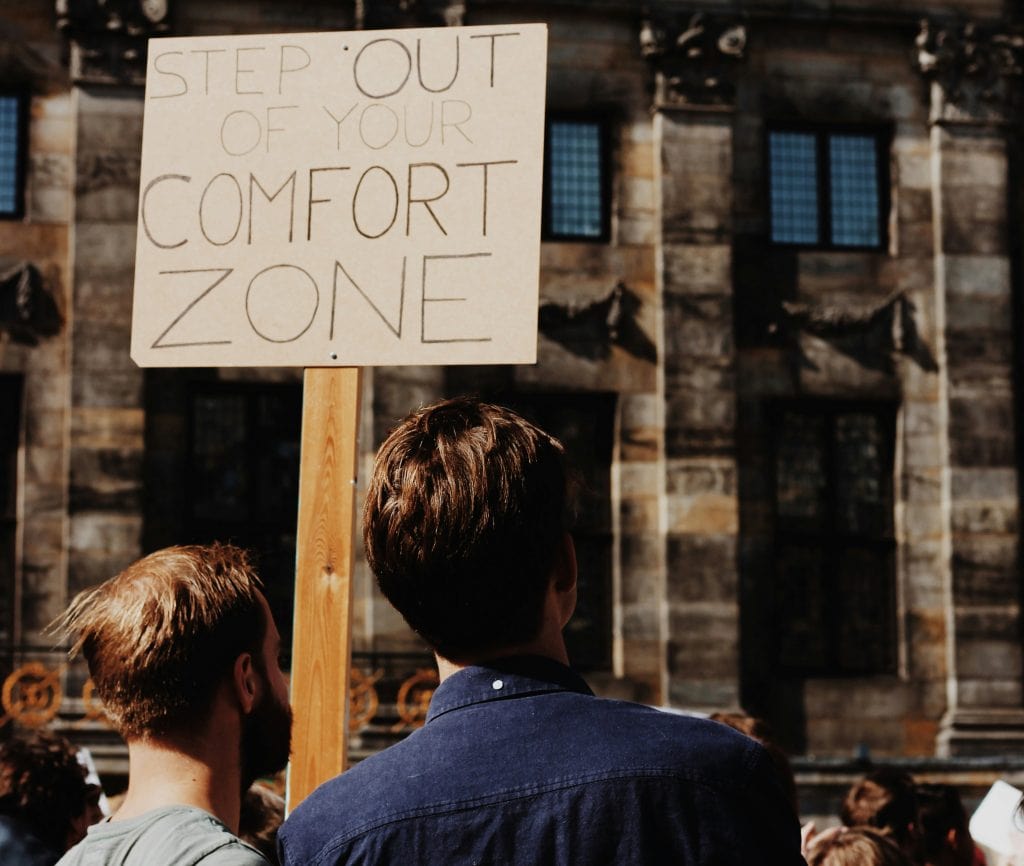
The refusal to do this ethical labour of discomfort was apparent with the film screenings and has become cemented as the overarching response to any calls to engage with the question of Palestine. The often vague and undifferentiated utterance of “being uncomfortable” has come to mark a closure rather than an opening for learning.
Much like the “feel-good” empathy Norouzi criticizes, the statements of “feeling uncomfortable” function as a way of deflecting rather than reflecting on one’s complicity in colonial domination. Discomfort justifies the lack of accountability.
From a feminist point of view, discomfort can be an invitation to stay with and learn from; it is, as sociologist Rachelle Chadwick writes, “an affective intensity [which] matters for opening up resistant and anti-colonial feminist research practices and modes of knowledge production”.
Staying with discomfort can be a way of resisting the willful ignorance which the statement “it is complicated” invites. To commit to the ethical labour of discomfort in fact enables a more nuanced understanding of a complex situation. While we do not think that genocide or illegal occupation are in themselves complicated questions, the historical and geopolitical realities of Palestine are complex.
The privilege of centering certain discomfort over others
It is unsettling how the discomfort arising from calls for justice for Palestine and for recognizing our responsibility is legitimized. At the same time, discomfort with what is actually happening in Palestine, or with the silence and epistemic violence experienced by those who speak up, is predominantly not acknowledged. The epistemic violence therefore takes the form of not only silencing and disregarding forms of knowledge but also feelings.
Especially in the context of predominantly white scholars in a Western university, there is a specificity to the forefronting of certain feelings of discomfort over others, the refusal to take an ethical and moral stance, and the emphasis on “both sides”.
Philosopher Alison Bailey has conceptualized the problematic response to social justice claims as “privilege-preserving epistemic pushback”. According to Bailey, this is not merely an “occasional set of responses from a few random individuals who happen to be uncomfortable with social-justice topics”, but is instead a predictable, recurrent, and historically rooted reaction. “Like all forms of privilege, these discursive patterns are unmarked and circulate subtly”, as she concludes.
Much like the rhetoric of “all lives matter” – used as a diversion from “black lives matter” – the rhetoric of “both sides” functions as a form of willful ignorance. It is a refusal to centre the rights and lives of those who are oppressed, acknowledge complicity, or de-center privilege.
I am not claiming that our former colleagues are generally uncomfortable with social justice topics, but in this particular case, their reactions mirror global fault lines in political responses to the genocide. These reactions are not independent of racialized hierarchies and mechanisms of oppression and violence.
Calling for justice for Palestine is an anti-racist and anti-colonial project, and the systematic and wilful silence of our colleagues, and of academia more broadly, is not separate from these structures and the ways in which they play out.
Luca and Xin’s common conclusion: what happens if the silence continues?
For the more than two years following those film screenings, the loud silence has continued. We have witnessed a systematic re-framing and re-articulation of both nuance and discomfort during these years. Both have become a closure rather than an opening: an ending of the conversation rather than an entry point to reflection, accountability, and learning.
As we both value and respect the historical and political roots – and radical potential – of our discipline of gender studies, and related fields such as anthropology, we are left wondering about our complicity in colonial and epistemic violence, through the widespread refusal to engage and take a stance.
What is the meaning of critical feminist scholarship if we do not practice as we preach? If we consider only some forms of violence and injustice as deserving of condemnation, and only some who are oppressed as deserving of solidarity?
What is the point in teaching social justice or writing about equality if outside the classroom we are willing to stay silent as we witness the annihilation of Palestine and the eradication of international law? Have our political and radical roots been forgotten, or have some of us merely chosen to ignore them?
The ways in which Palestine solidarity and activism, perhaps the biggest student movement of the 21st century, will change the face of academia is yet to be seen. Already, the complicity and attachments to the colonial pasts and presents upon which universities are built, and the ways in which our leadership hides behind semantics in order to hold on to the status quo, have been made painfully visible.
The genocide has been called a litmus test for humanity. For those of us working in academia, it has also been a test of our integrity as scholars.
Perspectives on Palestine and Academic Solidarity -article series
Students, researchers and faculty members participate in pedagogical and activist practices to learn about and contest the ongoing settler colonial violence in Palestine. This collection of articles brings together diverse reflections on different types of pedagogical and activist practices and attempts at suppressing them through the authors’ own experiences.
Read the whole Perspectives on Palestine and Academic Solidarity -article series
Editorial team
- Editor: Saara Toukolehto
- Journalistic comments: Niina Ahola
- Language editor: Maija Sequeira
- Layout: Martta Mustalahti
- Illustrations: 1: photographer Luca Karhu Tainio. 2, 3, 4 and 5: Unsplash
- Featured image: Ina Rantanen
Readings
Ahmed, Sara 2008: Open Forum Imaginary Prohibitions: Some Preliminary Remarks on the Founding Gestures of the ‘New Materialism’. European Journal of Women’s Studies 15 (1). https://doi.org/10.1177/1350506807084854
Bailey, Alison 2017: Tracking Privilege-Preserving Epistemic Pushback in Feminist and Critical Race Philosophy Classes. Hypatia 31 (4).
Boler, Megan 1999: Feeling power: Emotions and education. Routledge.
Chadwick, Rachelle 2021: “On the politics of discomfort.” Feminist Theory 22 (4), 556-574.
de Jong, Sara, Icaza, Rosalba and Olivia U. Rutazibwa 2019: Decolonization and Feminisms in Global Teaching and Learning. Routledge.
Norouzi, Minou 2023: On Discomfort and Empathy in Rosalind Nashashibi’s Electrical Gaza (2015). https://www.maifeminism.com/on-discomfort-and-empathy-in-rosalind-nashashibis-electrical-gaza-2015/
Stoler, Ann 2009: Along the Archival Grain: Epistemic Anxieties and Colonial Common Sense. Princeton University Press.