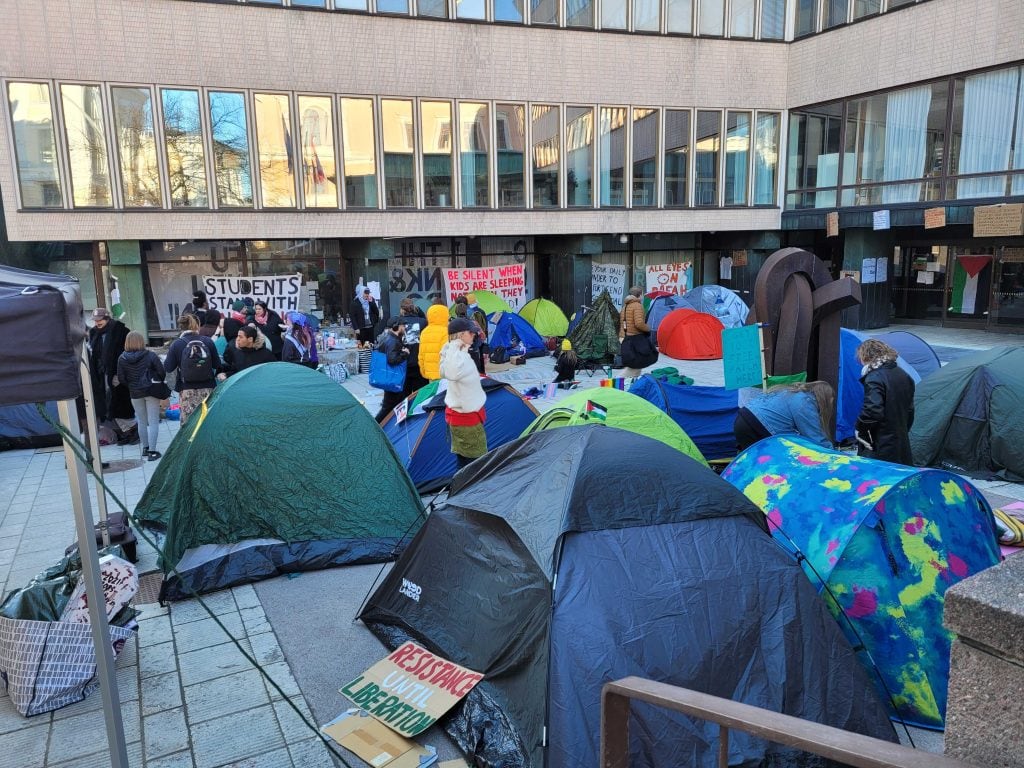
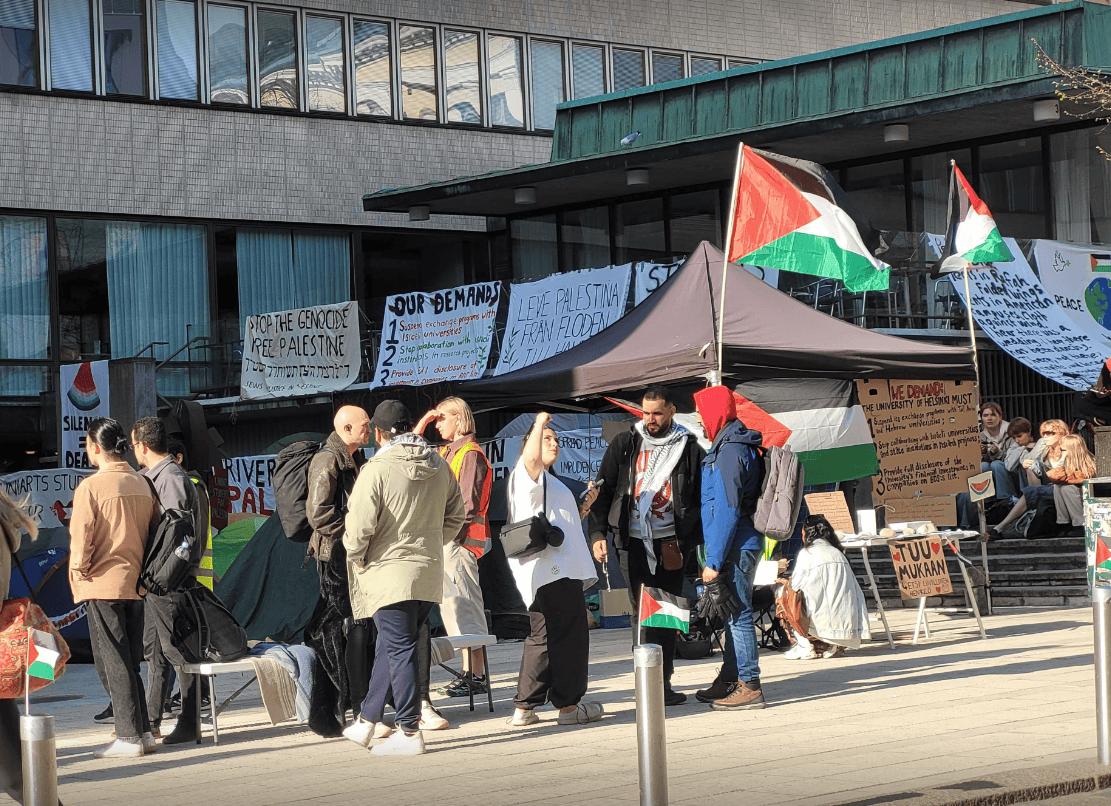
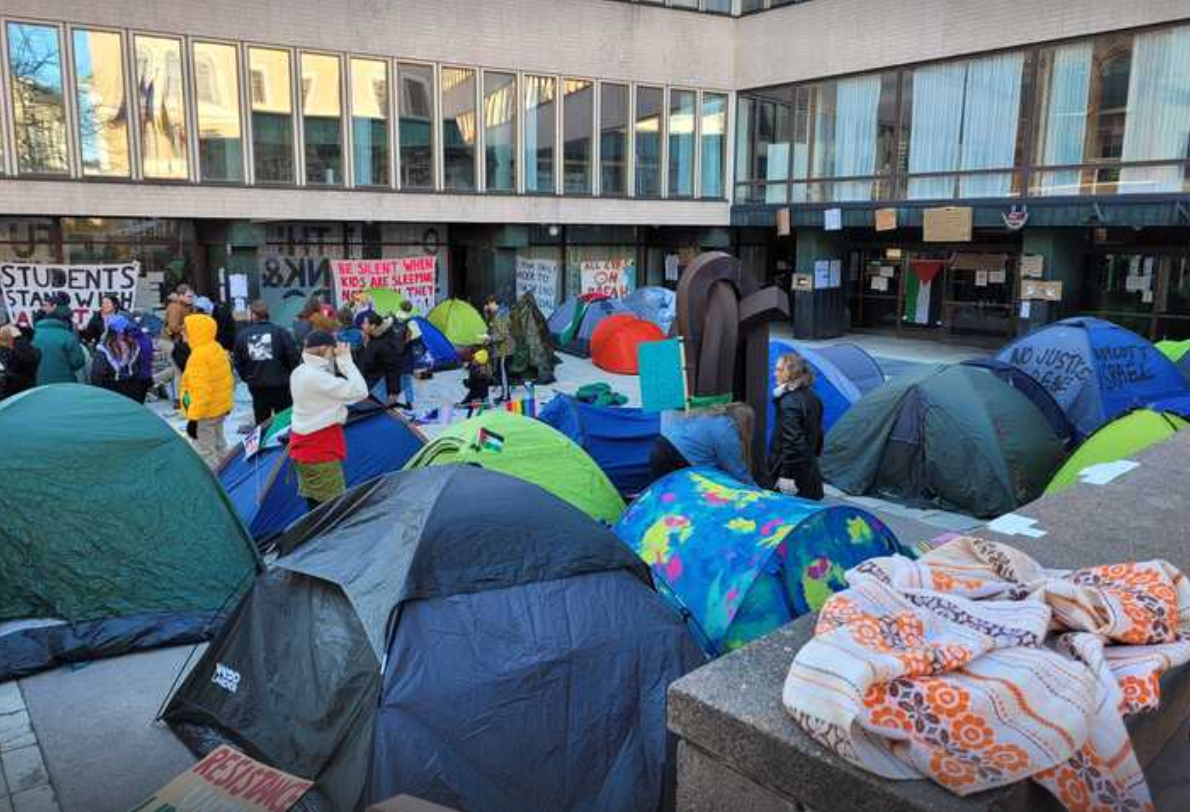
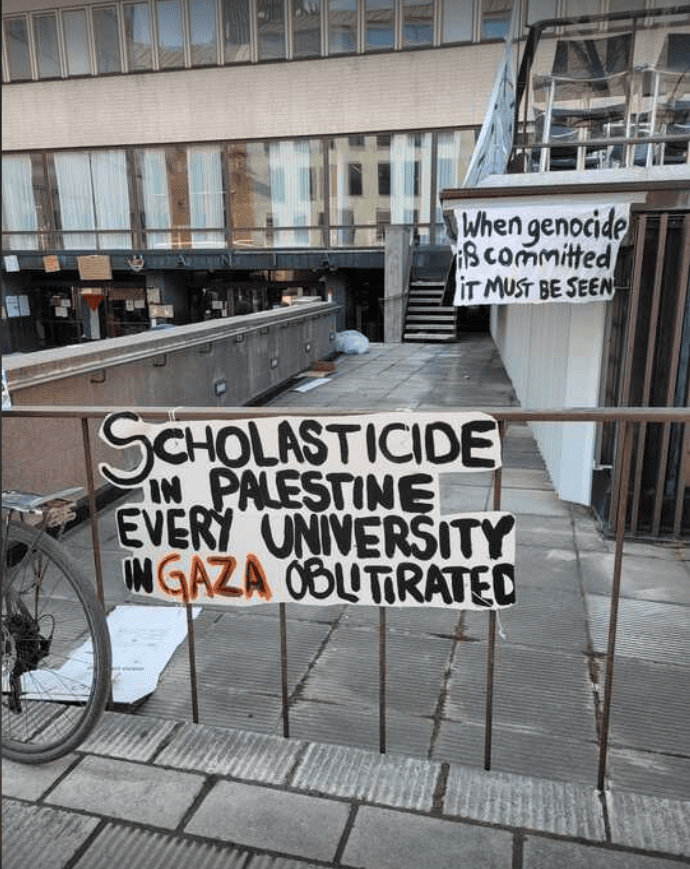
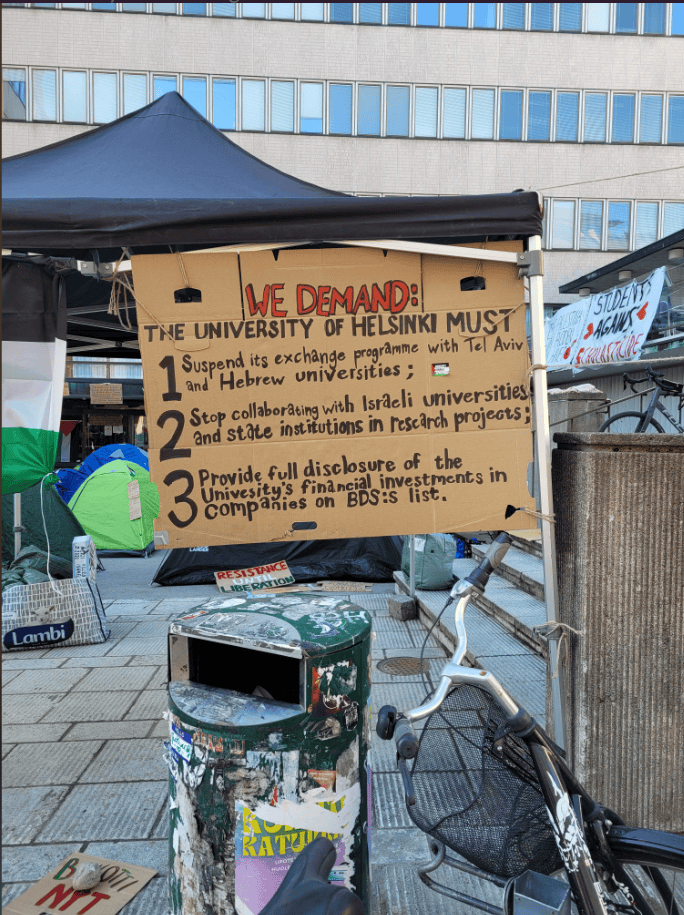
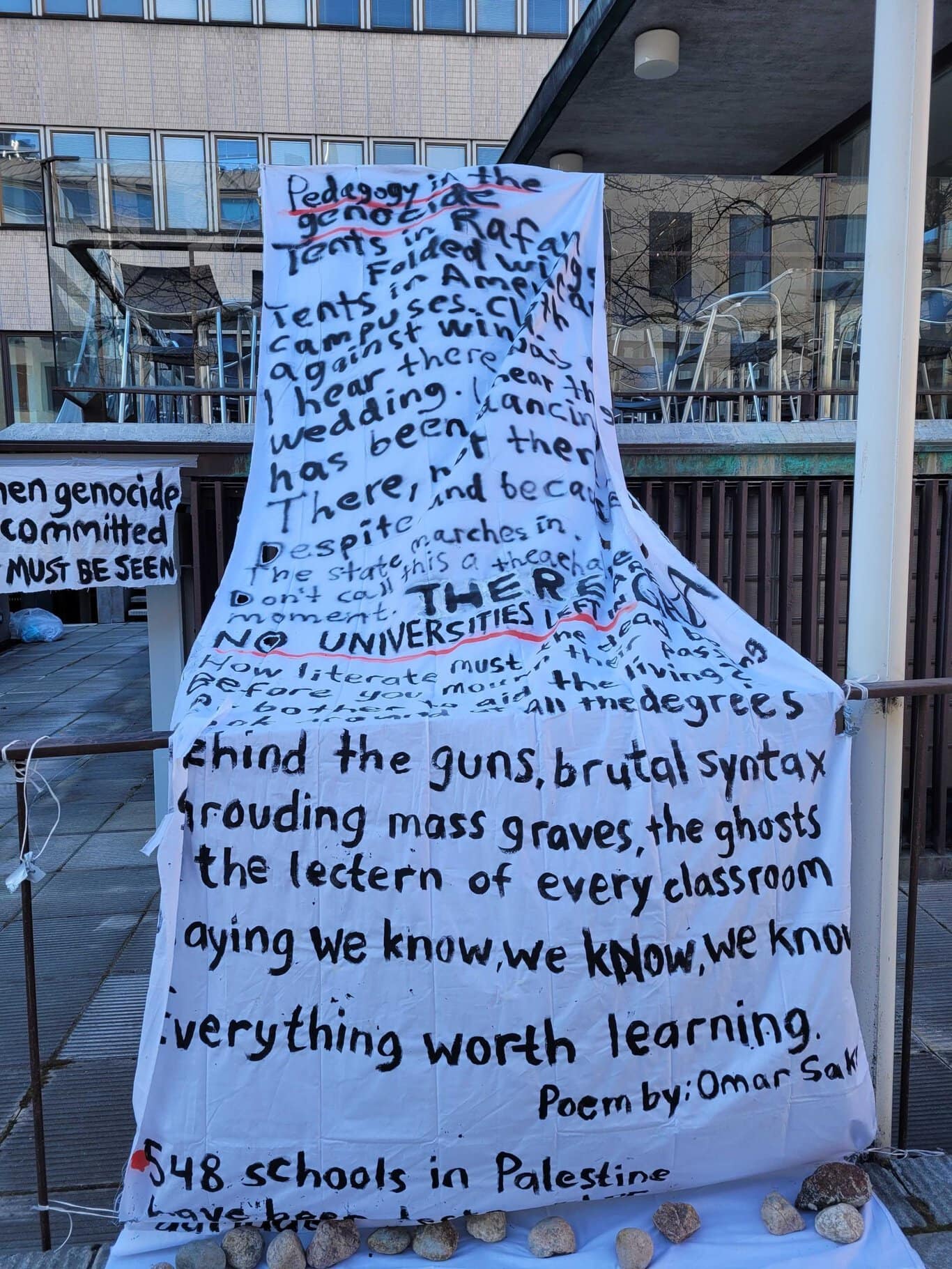
The Students for Palestine solidarity encampment stood for 38 days in front of the University of Helsinki’s Porthania building until it was removed by the police at the university’s request. For many of the participants, lingering feelings about not having done enough are entangled with more positive memories of the encampment and other forms of Palestine solidarity.
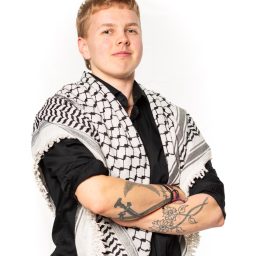
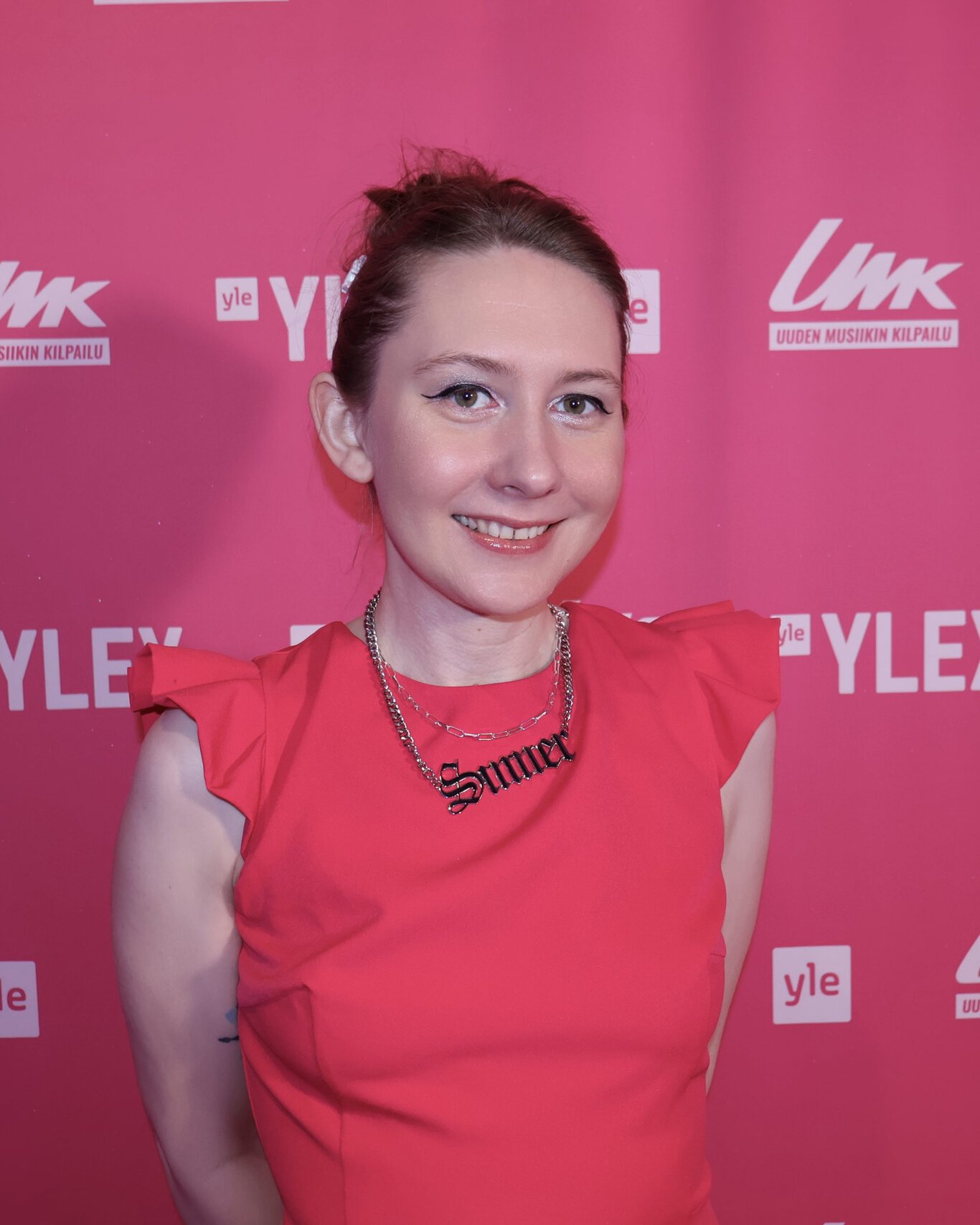
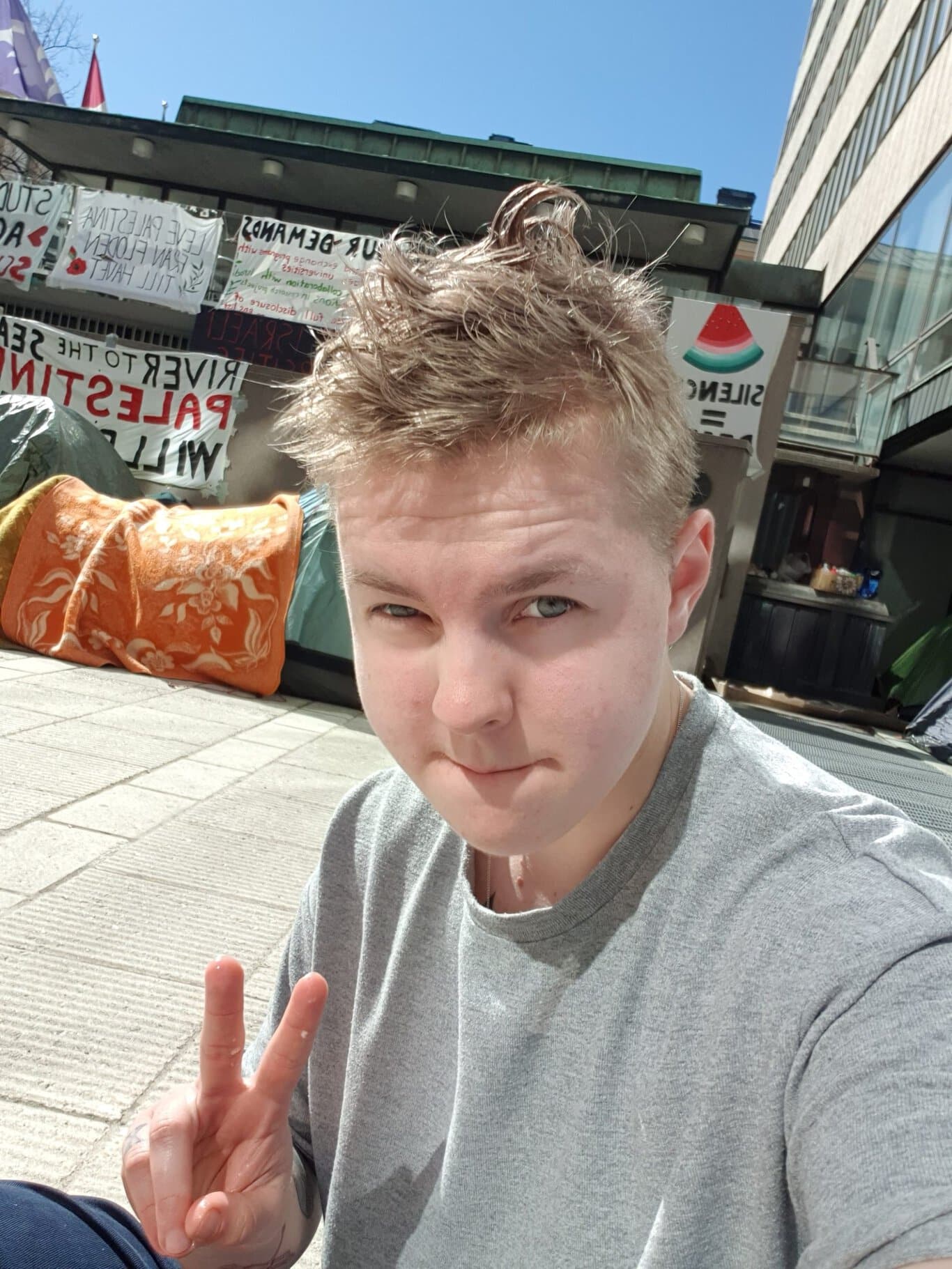
In this text, we, Alex Oksanen and Elena El Founti, explore the Students for Palestine encampment from two perspectives: Alex as a participant in the encampment and Elena as a researcher within human geography. Whilst we both share a commitment to strive towards solidarity, in this dialogue we speak from two wholly different perspectives on the encampment – one from within, and one from the outside.
Through the themes of ghosts and haunting, we reflect on navigating the realities and the emotional turmoil of Palestine solidarity activism. In doing so, we try to find ways of engaging and holding ourselves accountable. The encampment works as a site of overlap between our two individual journeys, as we stumble to find ways to act, and to put into words the unspeakable.
The text braids two timelines: Alex reflects on his participation in the Students for Palestine solidarity encampment in front of the University of Helsinki in 2024, and on visiting occupied Palestine through the volunteer organization Eyewitness Palestine in 2025. Elena considers what it means to research the same student encampment for her Master’s thesis one year after its violent dismantling by the police.
In the end we reflect on how these hauntings feed into our current solidarity activism, for example through Alex’s participation in the 2026 Global Sumud Flotilla, a civilian-led mission aiming to deliver humanitarian aid to Gaza.
The text is constructed as a dialogue between us, yet the consecutive paragraphs are only loosely related to each other. The dialogue style used here reflects on the friendship and solidarity that has developed between us in relation to, but not only in the context of, activism.
What drives us to do the things that we do?
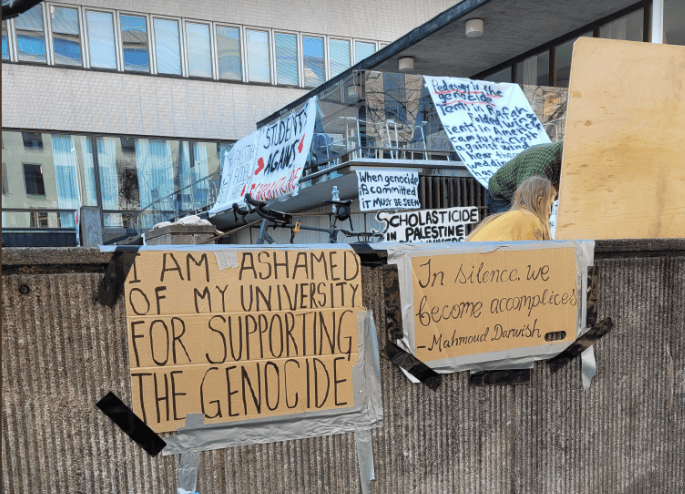
The Finnish Students for Palestine solidarity encampment began in Helsinki in May 2024, joining the international wave of student activism after the first solidarity encampment in Columbia University. The encampment in Helsinki stood in front of the central university building, Porthania, for 38 days after being forcibly removed by the police.
Alex:
As I made my way to the small courtyard of Helsinki University’s Porthania building, where several tents had been scattered for about a week, I wasn’t aware of the historical context of long-lasting settler colonialism. I did not know the history of the zionist movement or the ethnostate it wished to create. All I knew was that a genocide was going on and that innocent people were being killed.
I also did not join the encampment due to knowledge of our structural, economic and political complicity in these wrongs. No, I joined the movement out of an endless sense of doom and hopelessness – even panic. The questions running through my mind were not of strategically influencing the university’s decision-makers. Rather, they were fueled by the question of “what can I do, what can I do, what can I do?”
Elena:
One year after the demolition of the encampment, I sat down with five people who told me stories like these. Using hauntology as a methodology and theoretical background for my Master’s thesis, I aimed to attune to an encampment that was “gone” in our everyday understanding of the word. I was interested in what, if anything, lingers. How can we reach out to hauntings through interviews? What can I as a researcher draw from the ghosts that are presented to me?
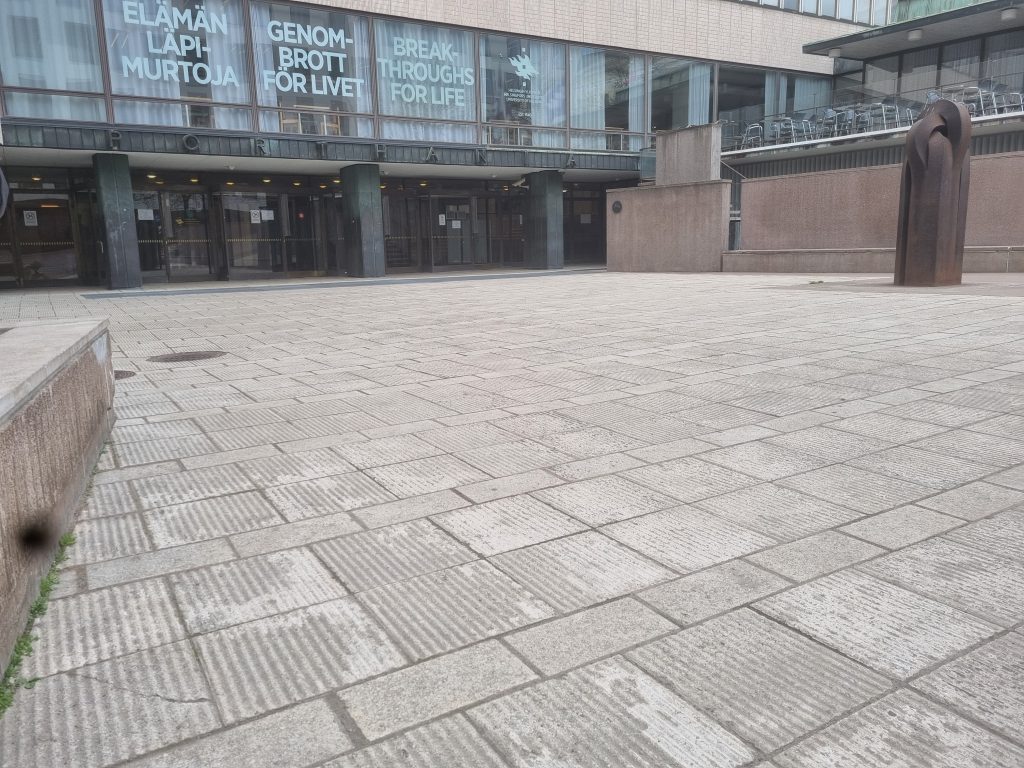
As I sat in the now-empty concrete square with the participants, I was presented with exactly these feelings, word by word: despair, the itch to do something, a haunting, unreachable push to act for a cause. With only an empty square in front of us, a ghostly pattern was woven: unbeknownst to one another, the interviewees expressed similar kinds of motivations, embodied emotions, fleeing ghosts of the landscapes elsewhere.
Alex:
What is left for one to do, when morning coffee is accompanied by images of dead children? When your body starts to go dull, numb even, from the continuous news about death in Gaza. Whatever the opposite of empowered is, that is how I felt, stepping timidly into the encampment, filled to the brim with tents and people who all seemed to know each other from before. I did not feel that the space was mine to claim, as I did not know anything, had not done anything to deserve it.
Little did I know that this encampment was the coming together of several different cultures, contexts, and peoples. All unified under one single banner: the knowledge that what we saw happening through our phone screens was morally wrong. And that something needed to be done about it.
Elena:
It dawned on me that the research of a haunting protest landscape, that is, a landscape that is not present as we vernacularly understand it, is not a quest for obvious answers. I thought the ghosts were simple creatures. But hauntology reminds us that the spectres entwine “the past and the present, the present and the absent”, as articulated by geographer John Wylie. The personal entangled into a landscape, made out of bodies, ideas, tents and precarious resistance.
Internal struggles may haunt as intensely as external ones: for some interview participants, it was mostly the personal battles, anxiety or the feeling of non-belonging that stuck. For others, it was the pervasive thoughts of wider injustice, and the passivity of the university in the face of a genocide, that haunted them the most.
Alex:
The first time I crossed that imagined boundary into the newly created space of the encampment, I left as quickly as I had entered. The panicked feeling of “god-why-don’t-I-do-something” prompted me to bring donuts to the people participating in the encampment, as a small and meek form of solidarity.
As I approached the camp, a kind-faced person greeted me, as they took the box into their hands and thanked me. I mumbled nervously in response and left. For some reason, my heart pounded as I made my march back home. A single thought haunted my mind for the remainder of the day: Why didn’t I stay?
Elena:
I am not sure if the hauntings were easier or harder to conjure in the same square one year later. The eroding forces of time make it harder to do research, which is based on other people’s memories, inklings, hauntings. Although now without the tents, the square was far from empty: the participants and I were constantly interrupted by familiar faces, newspaper vendors, and cars.
Conducting an interview in this square was not smooth – as if the space resisted going back to the past. Yet, the participants somehow succeeded in painting a picture of the space for me: here was the kitchen, this was my tent, there was this banner, this is where we danced dabke.
Alex:
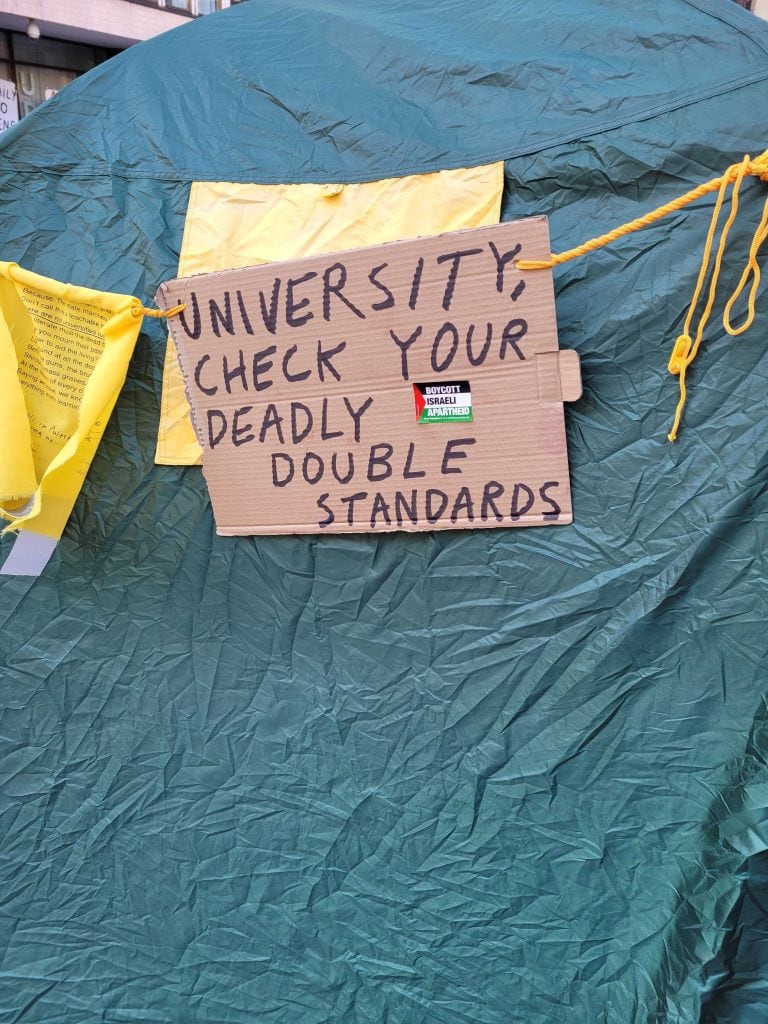
When I made my way to the encampment again a week or so later, I carried a newly acquired tent with me. If only I had known, many stood empty already, waiting to take me in. I carried a bag of sweets in my hand, as if that could somehow grant me claim to this territory, giving me permission to take part in the encampment. For the thought was still haunting in my head: You do not belong here. You do not know enough.
I think many people face this same fear, feeling they don’t know enough in order to speak out, to take a stance. Many feel that the intuitive gut feeling of something not being okay is not sufficient enough in order to boldly state “this is the side of history I want to be on”. And I completely understand that.
There is something safe about simply following from the sidelines as history unfolds, then afterwards stating “oh right, this was obviously the measured way to respond”, once all has come to light and the dust has settled. But then again, we already know the most central fact: people are being killed. And as we all know, every single person should have the right to life. Whether or not we know the backdrop of settler colonialism, upon which the ethnic cleansing of Palestinians is painted, we do know the simple and honest fact that they should not be killed.
Elena:
What is knowing enough? There was an interesting dichotomy presented to me: on the one hand, some participants feel like they “failed” academically because they skipped lectures to attend the encampment. On the other hand, some recall learning about resistance, reading new literature, and engaging in workshops, discussions and teach-ins.
One could almost see the academic ghost possessing the participants – the ghost that whispers that as an individual you will never be enough, that you can and should always perform better, be more effective, stay on the track that is agreed upon – not resist. In a way, I can attune to that idea, too.
In some moments, it feels like hours poured into academia are hours taken away from organizing, protesting and doing something more tangible. How to meaningfully do research within the academic bubble when one feels the need to “be more” in activism? How to justify only writing in the face of injustice?
Alex:
I would consider it a misrepresentation to say that my motives to join the encampment were “self-centered”. But I would say that in a certain way, that choice was driven by the self. What I mean by this is that there were several personal fears, worries and anxieties at play, when I decided to cross that mental border from “onlooker” to “participant” of the encampment.
There was worry of me not being a good person. There was fear of the world order that we were collectively letting ourselves slide into: one of indifference and complicity, where international law did not apply to all. It was an attempt at taking responsibility for the world which I inhabit, which treats others with deadly injustice. I participated in the encampment not only for the sake of the oppressed and the mistreated, for the Palestinian people, but also for being able to live with myself.
What I will have to face, though, is that it will never be enough. The ones murdered will remain dead, the bodies will forever remain maimed and the homes demolished will not magically build themselves back up. So much has already been lost, as our world remains silent. This fact will most likely haunt me for the rest of my life.
Elena:
A haunting is not only an academic vessel. Personally, the city is full of specters to me: I still recall routes of past marches, the exact places where sit-ins happened, where signs and banners laid on the cobblestones, the past resistances which did not yield the change they prefiguratively aimed for. Thinking with this, the encampment was also a project underlined with the shame of knowing too little and the anxiety of not doing enough.
For my Master’s thesis, I asked myself: What can I write about that matters to me? What kinds of writing can be personal, but still aim to extend to the other, create representations that seem to matter? Although mostly a methodological effort to look at specters through a qualitative lens – that is, hauntology combined with interviews – it also felt like an important attempt to voice past resistances. Following the thinking of philosopher Walter Benjamin, we arrive at the idea that past losses or demolished encampments should not be seen as failures, but rather unfinished stories, struggles to be exploded into future action.
Alex:
I think many will slip into this simplistic thinking that the encampment was merely a beautiful coming together of perfect, moral individuals. And what I will say is that the solidarity and coming together of these people was at times very touching and beautiful. But this narrative makes things all too simple. In reality, there was conflict, there was disagreement, there was burnout. It was a coming together of imperfect, incomplete people, who were simply trying to do the right thing.
Resources and people were scarce and the workload piled up on the shoulders of a few individuals, leading to frustration and passive-aggressive messages. Even now I am haunted by the fact that I could have done more. I am haunted by the fact that as my fellow participants were hauled away from the encampment by the police in the dead of night, I wasn’t there. Video upon video came up on my feed, showing as they were dragged and carried out by cops that had been called on to do so by my own university.
The next day, the university published a short notice about the eviction of the encampment due to ”experiences of threat to overall security” – threat to whom? I left a comment stating that as a participant myself I witnessed no threats or threatening behavior towards any singular individual, but instead to a culture of complicitness. The question that remains is this: for how long will we prioritize white comfort over the lives and homes of black, brown and indigenous people?
Elena:
It so often happens that activists are portrayed as monoliths of vigilance, people who innately have an exceptional calling for ethical obligations and therefore can be sidelined by others. There is this idea that “the activists” will go out on the streets, repost on social media, and be political so that others don’t need to. This othering takes many forms, and was echoed in many interviews: from the media treating the encampment as a spectacle of sleeping students to marvel at, to the belittling comments made by university representatives.
What we forget is that activism is not always heroic or beautiful, nor an innate quality. In my thesis, I argue that the horizontal structure of the encampment not only gives it its malleable, fruitful, spontaneous nature, but also comes with the potential for burnout, agonistic conflict, and threats to bodily safety. It’s a double-edged sword in a way, since the landscape consists of ordinary humans who resist and tire as ordinary humans do – who are not used to sleeping in tents in a busy square. But there is a point in breaking the habitual not only as a means of resistance but also in the context of academic knowledge-production: by pushing through rigid margins found within academia and in organizing, we arrive at new, more sustainable realities.
What continues to haunt us to this very day?
Alex:
Just the other day, I read a text written by indigenous scholar Kim TallBear about the concept of “standing with” the community that one researches or is working with, instead of “giving back”. In the fall of 2025, I visited the occupied West Bank for a total of four weeks. The trip was organized by a US-based NGO called Eyewitness Palestine, with the intention of having participants “witness” the brutal occupation that the Palestinian people live under, in order to strengthen and deepen the participants’ solidarity with them.
The trip changed something in me, fuelling my anger as it deepened my understanding and feelings of solidarity. The thought presented by TallBear stuck with me, as I was left to wonder: Was I standing with the Palestinians that I met during my visit, or was I instead simulating this classical idea of “giving”?
After coming back home from the trip, I met with a fellow comrade for lunch, who at one point asked me about the short videos that I had posted on Instagram about the places I visited. My intention was to share the stories of the cities and villages, to tell their names and to try and “stand with” them by sharing their experiences to the world.
I would start each video by saying, “Hi, my name is Alex, and I am currently in the West Bank”. “The video clips that you made during your trip, was it intentional that you put yourself in the forefront?”. The question stung. Not because I assumed there to be any ill intentions, but because I feared the sliver of truth that their question might hold. What if I was making it all about myself? Have I been going about this all wrong?
I answered the question that my lunch companion asked me. Yes. It was in fact a conscious choice. As problematic of a setting as it may be, I knew that my perceived whiteness and Finnishness would be able to bridge the gap of empathy between the Finnish audience and the Palestinians. I knew that they needed a non-threatening, Finnish-speaking person to tell them what the Palestinian people have been telling us for the last 78 years, in order for them to listen.
Elena:
The spectre needs a body to haunt, as sociologist Avery Gordon recalls. In my body, it felt hard to let go of the thesis, even though I knew it was ready. Researching an encampment and its ghosts became intoxicating. Hauntology and resistance started warping into a mirror maze: the spectres uncovering in relation to each other, calling further in to get lost into the hauntings, questions, and fleeting answers. How can such elusive cosmology conclude with something grounding? It felt like there was always more we could learn from a ghost.
As philosopher Jacques Derrida reminds us, hauntology can amplify the silenced voices: “If he loves justice at least, the ‘scholar’ of the future, the ‘intellectual’ of tomorrow should learn it and from the ghost”. What could we hear in the rubble of resistance? The question remains: how do we learn from the ghosts, and transform the haunting past into action that can lead the way?
The asynchronous nature of resistance is what haunts me the most. We have had people facing genocide, criminalization and authoritarianism before, and we will likely see this increasing in the future. I think, fundamentally, that this is what brings me back to ghosts – I think they know more than we do. I don’t know if it is naïve, but I think asking what could have been done is as relevant as asking what we should do next.
One could say, what I am haunted by is the ghostly nature of myself: in future retrospect, we are ghosts for generations to come, because what has happened conditions us. Thus, what we do indefinitely matters to the future.
Alex:
Thinking about oneself in a critical way is at times difficult, uncomfortable even, which is exactly why I find it important. For if we turn away from all that which is uncomfortable, will we not continue to turn away from the ethnic cleansing and genocide that are taking place, whilst Europe silently watches and actively gives monetary and military support? In the end, is genocide not something that should make us uncomfortable?
The difficulty with trying to do at least something, is that you might still fail, you might do or say something wrong. Which is probably why so many opt for silence. These same kinds of conversations would come up as I told people about my participation in this year’s Global Sumud Flotilla mission. For if we were to only consider the methods that we know to be 100% successful, with no chance of failure, we would end up doing nothing at all. And I for one am more willing to try out something that might fail, than to not do anything at all.
Elena:
The notions of failure and urgency kept coming up in the research. If looked at from a wider timeline, Palestine activism and solidarity spans further than the recent years, and thus it is situated in a different timescape than other activist movements, such as the pre-Covid wave of climate action. This idea was voiced in the interviews as well: since the encampment is the continuum of a longstanding fight for dignity and freedom, the idea of grandiose, fast wins is illusory. Thus, it is possible to look at it as a part of the flow of resistance. And, instead of diagnosing it as a historical event already over, it can be fruitful to think of the encampment as a ghost that still haunts, a link in the chain of history yet to be continued.
Both:
So, what continues to haunt us to this very day? There is no escaping who we are, or what we have and haven’t done. We want to underscore the importance of researching landscapes and resistances that haunt, of reaching into the past to try to understand how things could be otherwise, and indefinitely continue to matter. In these times of rising authoritarianism and ongoing genocide, it feels that there is an ever-growing need for research that attunes to the demolished landscapes that no-longer-are, but keep on affecting.
We want to conclude with the notion that there is always more that could have been done. And none of it will change the fact that at least 80 000 Palestinians have been killed in Gaza. It won’t change the fact that millions of people have been forced out of their homes since the Nakba in 1948. These facts remain, and will continue to haunt us, no matter what we do.
Perspectives on Palestine and Academic Solidarity -article series
Students, researchers and faculty members participate in pedagogical and activist practices to learn about and contest the ongoing settler colonial violence in Palestine. This collection of articles brings together diverse reflections on different types of pedagogical and activist practices and attempts at suppressing them through the authors’ own experiences.
Read the whole Perspectives on Palestine and Academic Solidarity -article series
Editorial team
- Editor: Saara Toukolehto
- Reviewers and curators of the series: Xin Liu-Toivanen and Luca Karhu Tainio
- Language Editor: Maija Sequeira
- Article web layout: A.S.
- Article image: Ina Rantanen
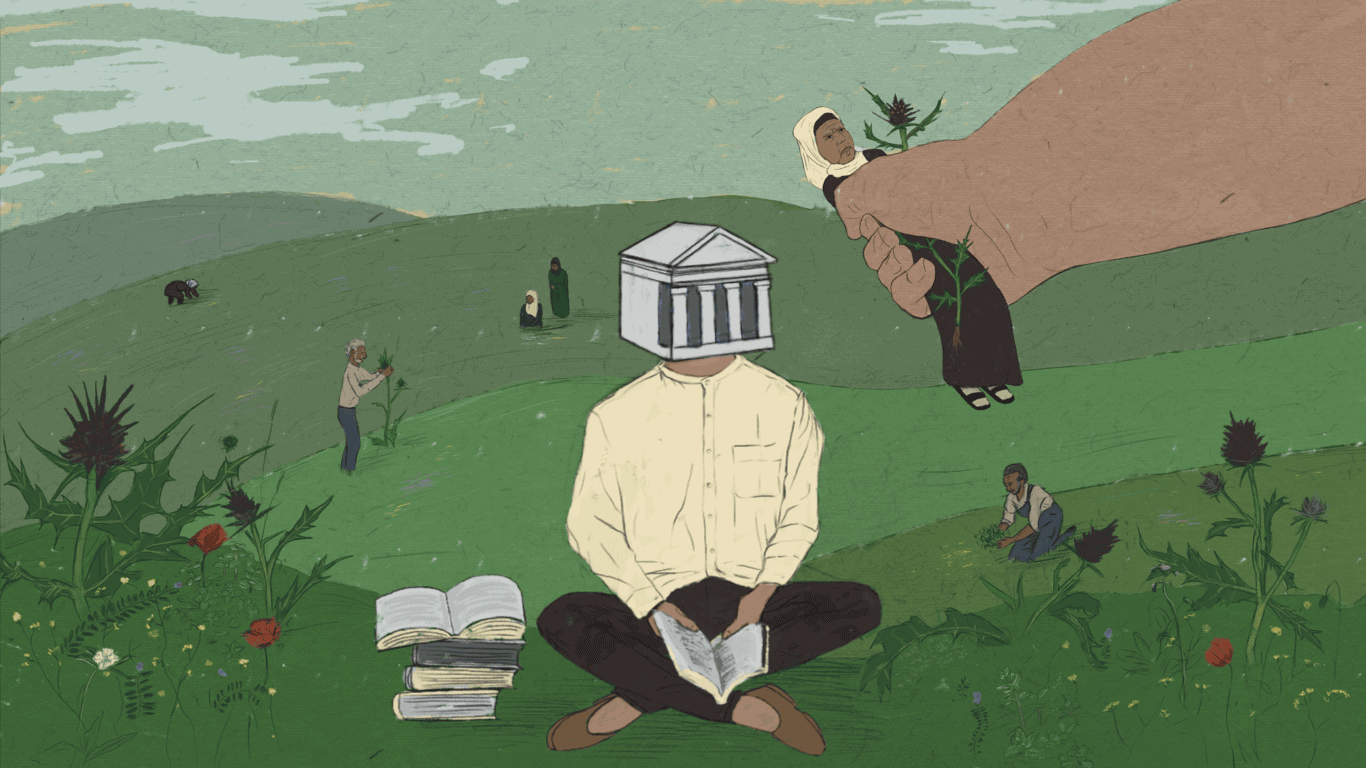
- Photos: 1: Photographer Alex Oksanen; 2, 3 and 5: Photographer Saara Toukolehto; 4. Image carousel: selfie by Alex Oksanen, others by Saara Toukolehto
Readings
- Benjamin, W. (2020). Theses on the Philosophy of History. In Critical theory and society (pp. 255-263). Routledge.
- Derrida, J. (1994). Specters of Marx : the state of the debt, the work of mourning, and the New international. Yhdistynyt kuningaskunta: Routledge.
- El Founti, E. (2026). The spectral landscapes of a Students for Palestine solidarity encampment.
- Gordon, A. F. (2008). Ghostly matters: Haunting and the sociological imagination. U of Minnesota Press.
- TallBear, K. (2014). Standing with and speaking as faith: A feminist-indigenous approach to inquiry [Research note]. Journal of Research Practice, 10(2), Article N17. Retrieved from http://jrp.icaap.org/index.php/jrp/article/view/405/371
- Wylie, J. (2009). Landscape, absence and the geographies of love. Transactions of the Institute of British Geographers, 34(3), 275-289.